


Savitribai Phule
Syllabus: GS1/Personality in News
Context
- Union Home Minister Amit Shah paid tribute to Savitribai Phule on her death anniversary.
About Savitribai Phule (1831 – 1897)
- Born in Naigaon village of Maharashtra’s Satara district.
- In 1840, at the age of nine, she married Jyotirao Phule, who was just 13 at the time.
- Formally recognised as India’s first female teacher. In 1848, the couple established the country’s first school for girls in Bhidewada, Pune.
- In 1863, Jyotiba Phule and Savitribai began Balhatya Pratibandhak Griha, India’s first home dedicated to prohibiting infanticide.
- She also advocated inter-caste marriages, widow remarriage, and eradication of child marriage, sati, and dowry systems, among other social issues.
- In 1873, the Phule’s set up the Satyashodhak Samaj (‘Truth-seekers’ society’), a platform open to all, irrespective of their caste, religion or class hierarchies, with the sole aim of bringing social equity.
- Literary works: Kavya Phule (Poetry’s Blossoms) in 1854 and Bavan Kashi Subodh Ratnakar (The Ocean of Pure Gems), in 1892.
Source: PIB
Kurumba Painting
Syllabus: GS1/ Culture
In News
- The Kurumba art tradition is facing the threat of extinction due to declining practitioners.
About
- Kurumba paintings trace back over 3,000 years, linked to rock art sites like Ezhuthupaarai in Tamil Nadu’s Nilgiris; they were practiced by the Kurumba tribe.
- The Kurumba tribe is classified as a Particularly Vulnerable Tribal Group (PVTG).
- Originally they were painted over the house walls, temple walls or during festivals and artists derive natural pigments from forest sources like tree resins.
- These folk paintings illustrate rituals, festivals, honey hunting, nature, animals, and daily community activities using simple linear motifs, dots, lines, and geometric patterns.
Source: IE
Fiscal Health Index 2026
Syllabus: GS2/Polity and Governance
Context
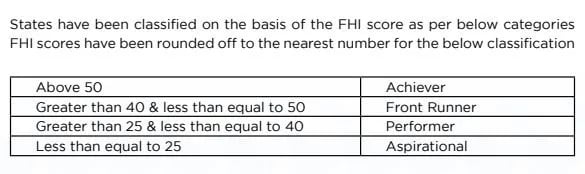
- NITI Aayog has released the second annual edition of Fiscal Health Index (FHI 2026.
Key Highlights of FHI 2026
- Overall State Rankings:
- Odisha remains the top-performing state, further improving its fiscal score.
- Goa and Jharkhand also feature among the Achiever states.
- Gujarat and Maharashtra continue to remain in the top five.
- Haryana shows a notable improvement by gaining three ranks.
- States Showing Recovery:
- Bihar, Karnataka, and Telangana demonstrate moderate improvement in fiscal performance.
- Low-Performing States:
- Punjab, West Bengal, and Kerala continue to remain at the bottom of the rankings, reflecting persistent fiscal stress.
- NE and Himalayan States:
- Evaluated separately for the first time, Arunachal Pradesh tops as Achiever (strong revenue growth), followed by Uttarakhand;
- Himachal Pradesh and Manipur lag due to weak own-revenues (<5% GSDP) and fiscal stress from high committed expenditures.
- Policy Recommendations:
- Priorities include boosting own-tax capacity (e.g., property, excise reforms), elevating capex to 5%+ GSDP, enhancing public financial management via digitization, and curbing off-budget borrowings to ensure debt sustainability below 25-30% GSDP.
Fiscal Health Index
- FHI initiative assesses the fiscal health of states in India.
- Sub Indices: Quality of Expenditure, Revenue Mobilisation, Fiscal Prudence, Debt Index, and Debt Sustainability.
- Data for the index is sourced from the Comptroller and Auditor General of India (CAG).
Source: PIB
National Shipping Board (NSB)
Syllabus: GS2/Governance
In News
- The government held a high-level interaction with the National Shipping Board (NSB) to address emerging challenges in India’s shipping sector amid evolving global geopolitical dynamics.
About National Shipping Board (NSB)
- It is India’s apex advisory body on shipping and maritime matters, constituted under Section 23 of the Merchant Shipping Act, 1958.
- It works under the Ministry of Ports, Shipping and Waterways.
- Its primary role is to advise the central government on shipping policies and maritime development.
- Its chairperson is appointed by the Central Government.
Source: PIB
International Energy Agency Releases 400 Million Barrels of Emergency Oil
Syllabus: GS3/ Energy
Context
- Amid escalating tensions in West Asia, the International Energy Agency (IEA) has agreed to release 400 million barrels of emergency oil reserves, the largest coordinated release in its history.
About
- Global emergency reserves: IEA member countries collectively hold 1.2 billion barrels of public emergency oil reserves and 600 million barrels of industry stocks held under government obligation.
- These reserves were established in 1974 after the 1973 Arab Oil Embargo to protect countries against sudden oil supply disruptions.
- IEA members have coordinated oil releases five times earlier:
- Gulf War (1990–1991)
- Hurricane Katrina in 2005
- Libyan Civil War (2011)
- Twice after the Russian invasion of Ukraine (2022).
International Energy Agency (IEA)
- The International Energy Agency (IEA) was set up in the wake of the 1973-1974 oil crisis to help industrialised countries respond to major oil shocks.
- Headquarters: Paris, France.
- Members: The IEA is made up of 32 Member countries including the United States, Canada, Turkey, United Kingdom, Australia, Japan, New Zealand, South Korea etc.
- Association Countries: India, China, Indonesia, Singapore, South Africa, Thailand etc.
- Criteria for membership: A candidate country to the IEA must be a member country of the OECD. In addition, it must demonstrate several requirements. These are:
- Crude oil and/or product reserves equivalent to 90 days of the previous year’s net imports,
- A demand restraint programme to reduce national oil consumption by up to 10%,
- Legislation and organisation to operate theCoordinated Emergency Response Measures (CERM) on a national basis.
Source: IE
Black Rain in Tehran
Syllabus: GS3/ Environment
Context
- The World Health Organization (WHO) has warned of “black rain” and toxic air pollution in Tehran, following attacks on oil facilities.
What is “Black Rain”?
- “Black rain” refers to rainfall contaminated with soot, ash, oil particles, and chemical pollutants that are released into the atmosphere after large fires or explosions.
- Instead of clear water droplets, the rain carries dark, oily particles, giving it a black or grey appearance.
- Such rain usually occurs when massive fires release pollutants into the air and rainfall absorbs these particles before reaching the ground.
- Historically, similar phenomena were observed after the Atomic Bombings of Hiroshima and Nagasaki in 1945, when radioactive soot and debris mixed with rainwater.
Source: IE
Kisan Credit Card (KCC)
Syllabus: GS3/Economy
Context
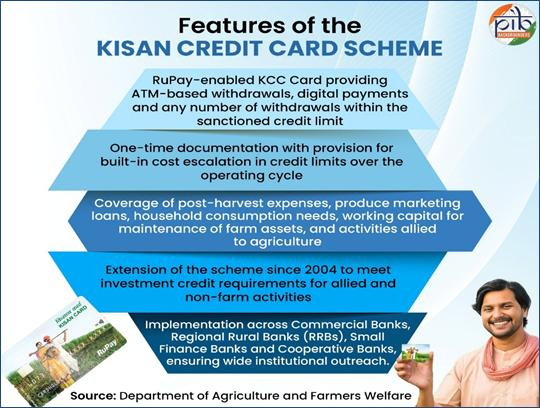
- The Kisan Credit Card (KCC) provides timely, affordable, and collateral-free credit to farmers, including small, marginal, tenant farmers and SHGs/JLGs.
Kisan Credit Card (KCC)
- The Kisan Credit Card (KCC) Scheme, introduced in 1998, was designed to simplify and expedite farmers’ access to short-term institutional credit for crop production.
- It provides working capital and investment credit for allied activities and covers post-harvest and marketing expenses, thereby offering comprehensive financial support to enhance farm incomes.
- Under the Modified Interest Subvention Scheme (MISS), the loan limit has been enhanced to Rs. 5 lakh, with collateral-free credit raised to Rs. 2 lakh per borrower.
- Eligible Beneficiaries of KCC: It extends coverage to:
- individual farmers and joint borrowers who are owner-cultivators,
- tenant farmers, oral lessees, and sharecroppers.
- In addition, the scheme also includes Self Help Groups (SHGs) and Joint Liability Groups (JLGs), including groups formed by tenant farmers and sharecroppers.
Source: PIB
Previous article
Changes in FDI Norms Linked to Land Bordering Countries (LBCs)
Next article
Women in Political Leadership
